Cosmic epochs relevant to our work (z = 127 → 0)
A single timeline
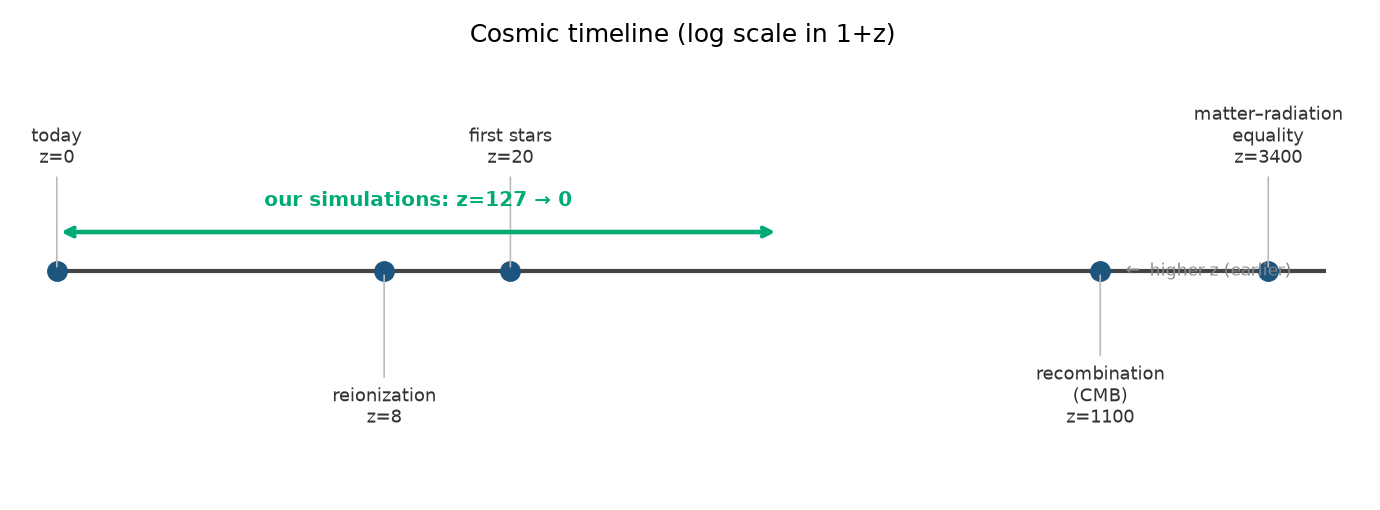
Because redshift maps monotonically to cosmic time, the whole history of structure can be laid on one axis (figure). Reading right (early) to left (late): matter–radiation equality, recombination, the dark ages, the first stars and galaxies, reionization, and today. Our simulations occupy the green bracket — they begin at $z=127$, long after recombination, and follow the growth of structure forward.
The epochs, in order
- Matter–radiation equality, $z\approx3400$ — matter starts to dominate; the power spectrum turnover is imprinted here.
- Recombination, $z\approx1100$ — the Universe turns transparent; the CMB we observe is emitted. Fluctuations are still $\sim10^{-5}$.
- The dark ages, $z\sim1100$–$30$ — no luminous sources; dark matter quietly grows its halos.
- First stars & galaxies, $z\sim30$–$10$ — the densest peaks collapse and light up.
- Reionization, $z\sim10$–$6$ — starlight re-ionizes the intergalactic medium; the Lyman-$\alpha$ forest (a key FDM probe, Topic 10.2) is laid down just after.
- Today, $z=0$ — 13.8 Gyr after the start.
Redshift as age
In a flat matter+$\Lambda$ universe the age at redshift $z$ is
$$t(z)=\frac{2}{3H_0\sqrt{\Omega_\Lambda}}\,\mathrm{arcsinh}\!\sqrt{\frac{\Omega_\Lambda}{\Omega_m}(1+z)^{-3}} .$$With $H_0=67.7$ and our densities this gives: $z=1100\Rightarrow\sim0.38$ Myr, $z=127\Rightarrow\sim13$ Myr, $z=6\Rightarrow0.93$ Gyr, $z=0\Rightarrow13.8$ Gyr. So our box starts when the Universe was only $\sim13$ million years old and runs to the present — the entire epoch during which halos assemble.
Cosmic time accumulates as $t=\int_0^a\frac{da'}{a'H(a')}$. For flat matter+$\Lambda$, $H=H_0\sqrt{\Omega_m a^{-3}+\Omega_\Lambda}$:
- $t(a)=\displaystyle\frac{1}{H_0}\int_0^a\frac{da'}{a'\sqrt{\Omega_m a'^{-3}+\Omega_\Lambda}}=\frac{1}{H_0}\int_0^a\frac{a'^{1/2}\,da'}{\sqrt{\Omega_m+\Omega_\Lambda a'^{3}}}$.
- Substitute $u=a'^{3/2}$, so $du=\tfrac32 a'^{1/2}da'$: the integral becomes $\displaystyle\frac{2}{3H_0\sqrt{\Omega_\Lambda}}\int_0^{a^{3/2}}\frac{du}{\sqrt{(\Omega_m/\Omega_\Lambda)+u^2}}$.
- This is a standard $\mathrm{arcsinh}$ integral, giving $t(a)=\dfrac{2}{3H_0\sqrt{\Omega_\Lambda}}\,\mathrm{arcsinh}\!\sqrt{\dfrac{\Omega_\Lambda}{\Omega_m}\,a^{3}}$.
Writing $a=1/(1+z)$ gives the redshift form used above. In the matter era ($z\gg1$) the $\mathrm{arcsinh}$ linearizes to $t\propto a^{3/2}\propto(1+z)^{-3/2}$ — the familiar $t\propto(1+z)^{-3/2}$ scaling of the early Universe.
Where FDM shows up on the timeline
The signature of fuzzy dark matter is delay. Because quantum pressure erases small-scale seeds, the first FDM halos cannot collapse until larger scales go nonlinear — pushing first collapse to much lower redshift than in cold dark matter. Our GAMER runs measure first collapse at $z_{\rm ff}\approx15.7$, versus $z\approx50$ for CDM: fuzzy dark matter builds its first structures roughly a hundred million years later. On the timeline, FDM shifts the "first stars" marker to the left.
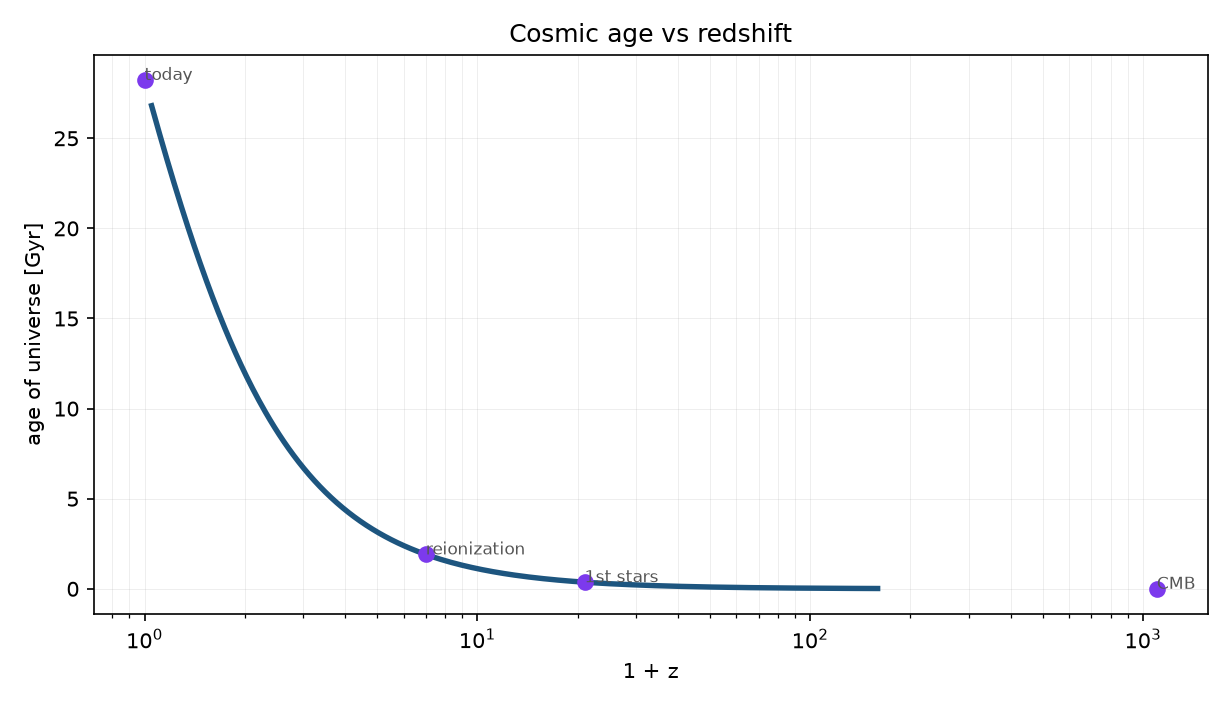
Every simulation snapshot is tagged by redshift, and this timeline is what makes a snapshot physically meaningful. Our headline FDM result on the timeline is the delayed first collapse ($z_{\rm ff}\approx15.7$) and the minimum halo mass — both consequences of the same small-scale suppression that flattens the mass function (Topic 7.4).
- Dodelson & Schmidt (2020), Modern Cosmology, 2nd ed.
- Loeb & Furlanetto (2013), The First Galaxies in the Universe.